In the sneaker and casual footwear market, design may catch the eye, but comfort is what keeps customers coming back. Terms like “cushioning,” “anti-fatigue,” or “energy return” are now everywhere in marketing campaigns. But how do you move from a slogan to a technical promise you can truly stand behind?
The answer lies in a laboratory test often associated with safety, but which has become a secret weapon for leading fashion and sports brands today: the heel energy absorption test.
When we walk, the heel strikes the ground and generates a shock. A stiff shoe transfers that shock directly up through the wearer’s body. A well-designed shoe, instead, acts as an efficient shock absorber.
In the lab, we measure exactly how much energy the outsole/midsole package can dissipate during impact.
If the value is low: the shoe “kicks back” into the foot (the typical feeling of a hard, “dead” sole).
If the value is high: the shoe absorbs the impact, delivering that soft, comfortable, less fatiguing walking sensation.
Test Methodology
The technical procedure—defined by international standards ISO 20344 (for PPE) or ISO 20865 (specific to conventional footwear)—is straightforward, yet rigorous:
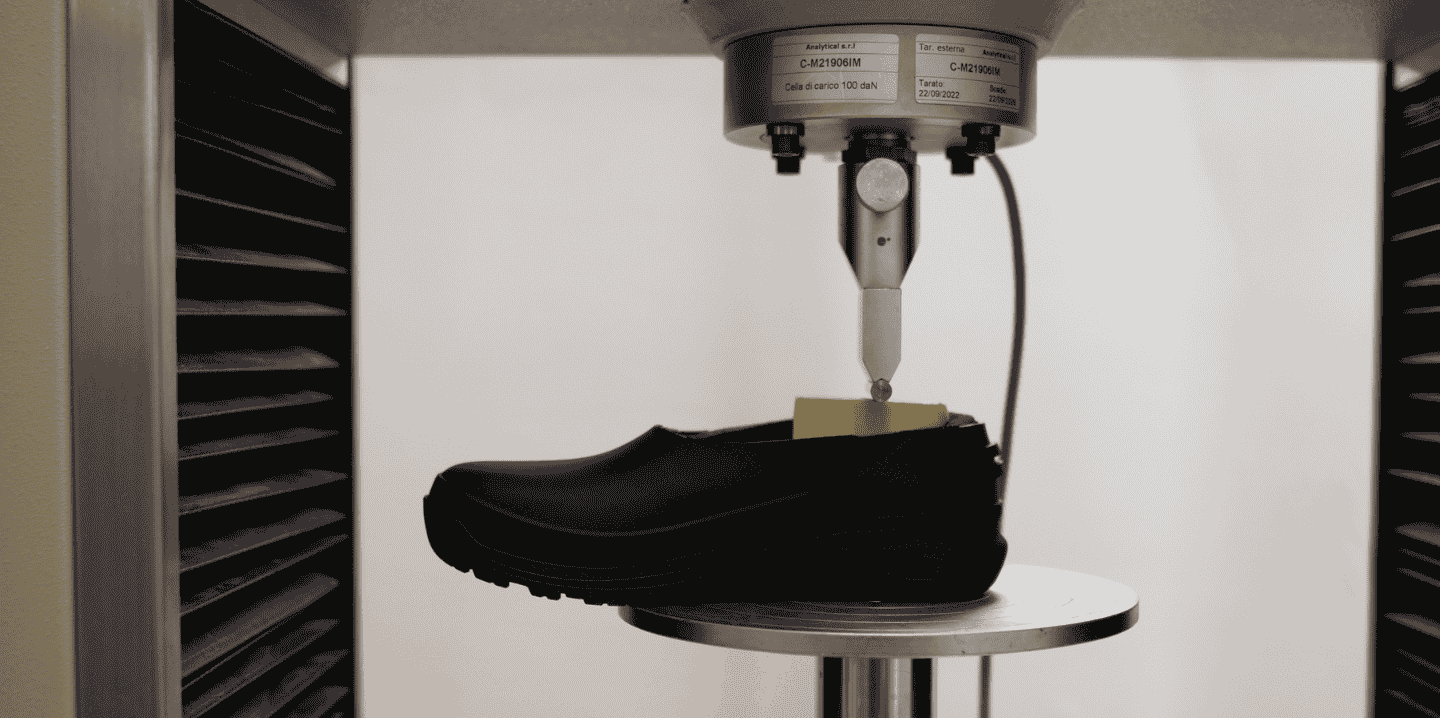
The sample: Testing is preferably performed on finished footwear for the most realistic outcome, but it can also be carried out on individual components, as long as they are assembled exactly as in the complete shoe.
The action: Once the sample is positioned under the dynamometer, an anatomical punch compresses the rear support area (outsole + midsole + insole) at a constant speed of 10 mm/min.
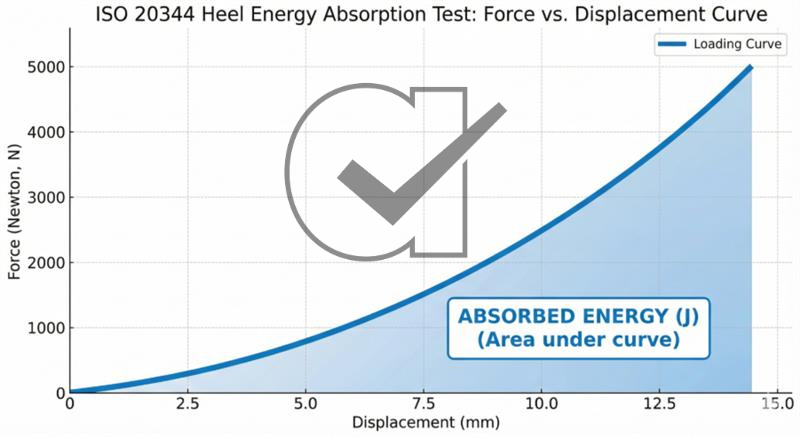
The limit: Compression continues until a force of 5,000 N (about 500 kg of load) is reached.
The calculation: The software analyses the deformation curve under load and calculates the absorbed energy in Joules (J).
Why should a fashion or sports brand run this test?
In most countries, for non-PPE footwear (i.e., not safety shoes), this test is not mandatory. Still, it is strategically valuable for three reasons:
Substantiating claims: If you print “Ultra-Soft” on the box, this test provides the technical data to back it up—helping avoid unsupported claims and turning “comfort” into evidence.
Benchmarking: You can compare your sneaker against a competitor’s best-seller. Is your prototype truly more comfortable?
Material control: Whether you change supplier for cost optimization or sustainability reasons (e.g., recycled or bio-based EVA), the test immediately tells you if performance matches the previous benchmark—preventing unpleasant surprises during production.
Export Focus: the mandatory case of India (BIS)
There is a crucial exception for exporters. While in Europe and the USA this test is voluntary for fashion/sport footwear, India has introduced very strict rules through the Quality Control Orders (QCO).
To sell sports footwear in India, it is mandatory to obtain BIS certification (Bureau of Indian Standards). The relevant Indian standard for sports shoes (IS 15844) requires rigorous performance testing. In this context, heel energy absorption stops being a marketing choice and becomes a technical compliance requirement: without passing the performance tests, products cannot be placed on the Indian market.
How to read the result
Think of the test graph as a snapshot of the sole’s behavior.
The target: A shoe is technically “comfortable” if it absorbs at least 20 J. High-end sneakers or professional running shoes often exceed this value significantly (30–40 J).
The graph: The area under the curve represents real comfort— the larger the area, the more the shoe is working instead of the customer’s joints.
Measurable quality, accessible market
The heel energy absorption test turns a subjective feeling (“it’s comfortable”) into an objective figure (“it absorbs 35 J”). For fashion and sports footwear manufacturers, it is an essential tool to validate quality—and, in the case of exports to India, a mandatory step for market access.
Do you need BIS certification for sports footwear in India, or do you want to quantify the comfort of your new collection with objective data?
Contact us: we support you in defining the right test plan, interpreting the results, and preparing the documentation required for placing products on the market.