


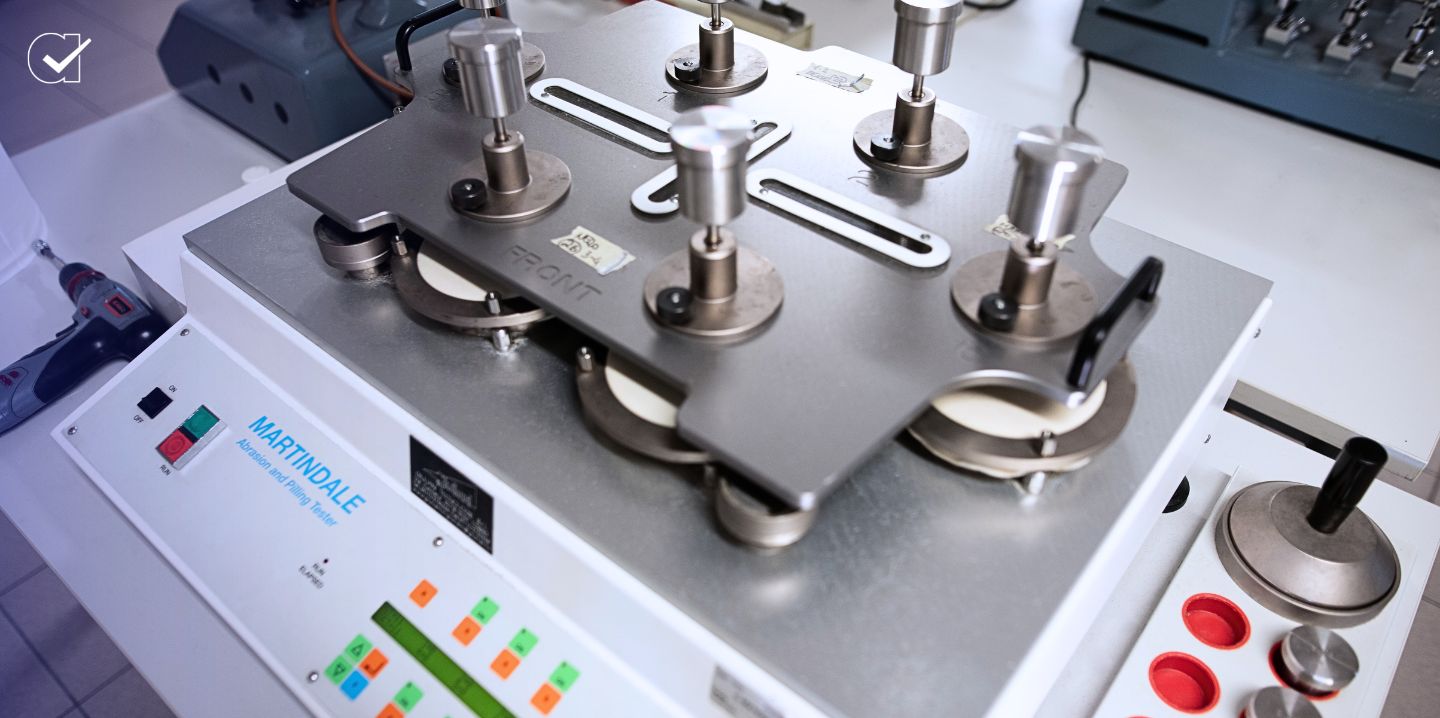
Lining complaints don’t arrive in production: they arrive in store.
Abrasion problems almost never surface during outgoing quality control at the factory: the material is intact, the workmanship is correct, the product passes visual inspection. Failure comes after a few weeks or months of use, when the shoe has already been sold and worn. At that point the damage is not just technical: it’s a return to manage and a dissatisfied customer.
Abrasion is a cumulative phenomenon: every step imprints a micro-cycle of localised friction on the internal material at pressure points, heel, toe, and ankle. Step by step, the material degrades and fibre failure sets in.
The Martindale test according to ISO 17704 is designed to anticipate in the laboratory what the market discovers too late. It is not a faithful simulation of use, no test truly is, but it is a standardised, repeatable and comparable measure, capable of distinguishing in advance between materials that would appear equivalent at the selection stage. And it applies equally to inner linings and to visible surfaces, such as the internal coverings of sandals and exposed quarter linings, where structural failure is compounded by visible aesthetic degradation, which the standard evaluates using distinct criteria that not all quality specifications monitor with equal attention.
Three risks a specification without data does not cover
By the time the problem becomes visible, the batch has already been distributed. The operational consequences for a brand unfold across three distinct levels.
The first risk is financial: returns, replacements, and out-of-contract management of non-conformities.
The second is commercial: a defect that emerges mid-season damages the relationship with distribution in ways that cannot be recovered in the following season.
The third is regulatory: in markets where abrasion resistance is a compliance requirement, for example for occupational footwear under EN ISO 20347, or certain export categories to regulated markets, the absence of technical documentation represents an exposure that no system audit alone can cover.

Methodology: from cycle to data
The Martindale machine replicates friction in a way that differs from any linear test: the specimen holder moves along a Lissajous curve, a closed figure that never repeats itself identically. This is the difference between rubbing always in the same direction and rubbing the way a foot actually does: unpredictably, multidirectionally, cumulatively.
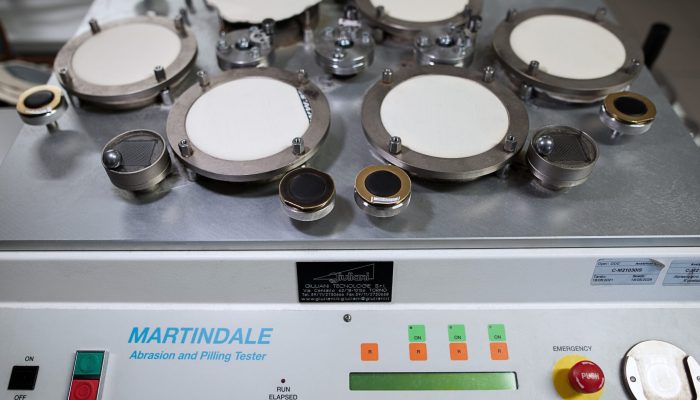
The sample is fixed on a flat specimen holder and brought into contact with a standardised abradant fabric under a predefined load. The machine counts the cycles; the technician evaluates the sample at set intervals, applying the reading criterion appropriate to the component under examination.
For inner linings and insoles, the breakage criterion is used: the test stops when the first hole forms, or when two or more threads of the surface layer break visibly. The result is the number of completed cycles.
For uppers and visible surfaces, such as internal sandal coverings and exposed quarter linings, an aesthetic evaluation criterion comes into play: the sample is compared at regular intervals against standardised reference scales to detect surface alterations that do not compromise the structure but degrade the perception of the product. Here “failure” is not measured by a numerical value but through a qualified judgement, which requires trained operators and controlled observation conditions.
Equipment: the right machine is not enough
In the laboratory, having a machine does not automatically guarantee the accuracy of the output. The Martindale test relies on a well-established and standardised piece of equipment, yet the reliability of the test depends entirely on the control protocols governing it.
- Load accuracy: ISO 17704 specifies a particular load for footwear, and a very common error in non-specialised laboratories is testing samples using the wrong load. This deviation invalidates the entire test.
- Another critical factor is sample mounting: if the mounting tension is not uniform, it has a significant impact on data quality.
One element that cannot be overlooked is the inherently subjective nature of the final evaluation in the Martindale test. However precise the mechanics may be, it is the competence of the laboratory technician that makes the difference. Subjectivity becomes objective and unassailable data only when the reading is performed by qualified personnel whose competencies are regularly validated through panel tests and participation in interlaboratory circuits.
Reference standards
Data produced only carries weight when it refers to a shared regulatory framework. For footwear there is no single standard, but various documents serving different functions — and understanding their hierarchy is essential for building or updating a specification.
At the centre is ISO 17704, footwear, test methods for uppers, linings and insocks, determination of abrasion resistance. The method standard specific to footwear, which defines differentiated operating conditions for uppers, linings and insoles and references ISO 12947-1 for the machine’s construction specifications. This is the document that governs how the test is performed.
Separate from the method is the question of requirements: what values a material must reach to be acceptable. For non-occupational footwear, the reference documents are ISO/TS 20952, footwear, requirements for upper materials and ISO/TS 20953, footwear, requirements for lining and insock materials, covering upper materials and lining/insole materials respectively. ISO/TS technical specifications are not mandatory, but they represent the most current international technical consensus for non-occupational footwear — and in the specifications of structured brands they are treated as fully operational references.
For occupational and protective footwear, EN ISO 20345 and EN ISO 20347 define binding minimum thresholds for internal materials based on risk category. In this context, abrasion resistance is a compliance requirement whose absence exposes the product to certification non-conformities.
Applications and use cases: three reasons to test even without obligation
The Martindale test is mandatory in certain contexts — and these are more numerous than one might think: beyond the regulated categories already covered by EN ISO standards, they include exports to certain regions of the Middle East, where technical performance documentation is a distribution access requirement even for non-occupational footwear.
But “optional” does not mean “irrelevant.” When does a certified abrasion value outweigh any subjective assessment?
The first case is claim substantiation. “Ultra-resistant lining”, “guaranteed durability”, “high-performance technical materials”: statements that appear regularly in product sheets. Without laboratory data to back them up, they are claims contestable by market surveillance authorities in European and North American markets, where the substantiation of product claims has become a central issue. A certified Martindale value transforms a qualitative statement into quantified evidence.
The second is supplier control. When managing a panel of lining, insole or upper material suppliers, abrasion resistance is one of the few parameters that allows direct, objective comparison between materials with very different structures.
The third is documented durability for PEFCR. The Product Environmental Footprint Category Rules for Footwear, still in the process of final adoption, builds the calculation of a product’s environmental footprint around the declared service life. Abrasion resistance tests are among the technical evidence on which that declaration is based.
What does it cost a brand not to know how the lining performs after three months of use?
Abrasion resistance of internal and external materials is a measurable, comparable parameter that can be built into a specification. It does not require rethinking the entire quality control structure: it requires deciding at which stage of the process that data needs to be available, and building the protocol accordingly. With PEFCR Footwear advancing and export markets increasingly demanding on technical documentation, that decision is best made before someone else makes it for you.
Our support
Contact us for an analysis of your material specification and to define a testing plan calibrated to your range, inner linings, insoles and visible surfaces.