
Indonesia Halal 2026: new BPJPH rules for exporting

Exporting to Indonesia in 2026 requires greater attention, stronger coordination and a higher level of compliance. BPJPH, the Indonesian authority responsible for managing the Halal Product Assurance system, has introduced three new regulations that directly affect market access.
These developments come within a regulatory framework already marked by a key deadline: 17 October 2026, the end of the transitional period established by the Indonesian system for product categories subject to Halal requirements.
Regulation No. 2/2026: a clearer framework for sanctions

Regulation No. 2/2026 does not introduce a new certification requirement, but it makes the risk of enforcement more concrete.

The regulation sets out the administrative sanctions that may apply in the event of violations of the Indonesian Halal system. Depending on the severity and nature of the non-compliance, consequences may include written warnings, revocation of the certificate or registration, withdrawal of products from the market and, where applicable, destruction of the goods.


For exporters, the message is clear: the new requirements on labelling and shipment are not merely formal obligations, but requirements that must be managed accurately.

Regulation No. 3/2026: Non-Halal labelling becomes standardised

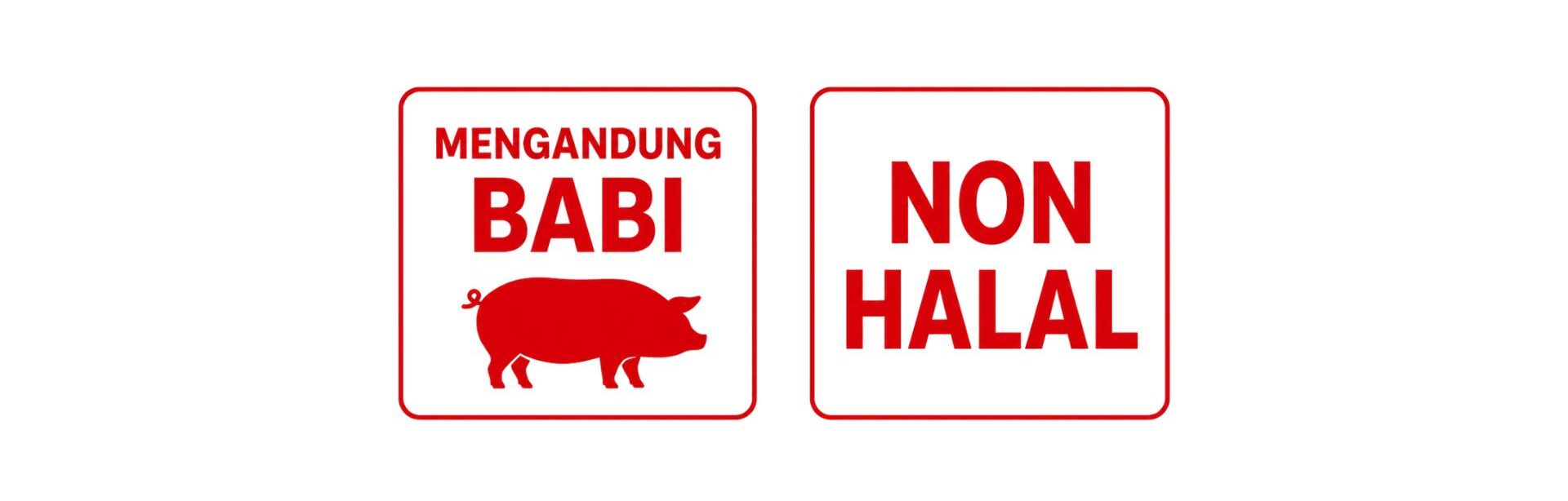
With Regulation No. 3/2026, BPJPH defines precisely how a Non-Halal product must be identified.

There are two main cases:

  • If the product contains pork or pork derivatives, it must display the wording MENGANDUNG BABI, together with the image required by the regulation.
  • If, on the other hand, the product is NON-HALAL because it contains other prohibited ingredients or due to the production process, it must display the wording NON HALAL, according to the prescribed graphic format.
In both cases, the indication must be visible, legible and not easily removable.
Indonesia Halal 2026: new BPJPH rules for exporting - 1
One point to clarify: a product “under certification” is not automatically Non-Halal
A product that is still undergoing Halal certification should not automatically be labelled as Non-Halal unless there are specific elements in its composition or production process that make it so.
 
The regulation therefore does not create a “Non-Halal certification”. It only defines how an actual Non-Halal status must be declared. The real priority is to complete the certification process correctly within the required timeframe.

The transitional period

The regulation provides for a 12-month transitional period for labelling adjustments.
 
However, this period should not be interpreted as a general extension of the Halal certification deadline. It concerns the adjustment of products that were already in circulation or already marketed before the regulation entered into force.
 
It is therefore important not to confuse the two aspects: adapting Non-Halal labelling is one matter; complying with the overall Halal system deadline is another.

Regulation No. 4/2026: a new step in the shipment process

Regulation No. 4/2026 is, in all likelihood, the most relevant measure for foreign companies. It introduces the pre-shipment Pemastian Produk Halal, a conformity check that must be completed before the import customs declaration.
 
The check does not concern only the Halal certificate or foreign registration. It also verifies the consistency of the entire shipment. For example, the following information must be aligned:
  • certificate or registration;
  • HS code;
  • invoice and packing list;
  • SKU, batch or lot;
  • quantities;
  • production dates and data;
  • product labelling;
  • loading conditions and traceability.

The verification is carried out at the loading warehouse, in the country of origin or departure, before the goods are shipped. If the outcome is positive, an electronic LPPH is issued. It is valid for one shipment only and must be available before customs clearance.
 
The product must therefore not only be compliant: it must also be documentally consistent and logistically ready.

Products still undergoing certification

One of the main risks concerns products whose certification process has not yet been completed.
Submitting a certification application is not equivalent to holding the certificate or registration number required under the new import process.
At the same time, this delay cannot be resolved by temporarily applying a Non-Halal label.

If the product category is already subject to the requirement and the shipment must leave, the real issue is that the goods may not yet be import-ready.

What companies, exporters and importers should do now

Companies exporting to Indonesia should focus on four main areas.
  1. Product mapping: ingredients, materials and production processes should be reviewed to determine whether the product can be Halal certified, is genuinely Non-Halal, or is still undergoing adaptation.
  2. Document verification: certificates, registrations, product codes, HS codes, batches, invoices and packing lists must be consistent.
  3. Packaging and labelling: these must correctly reflect the declared status of the product.
  4. Shipment preparation: this includes coordination with the importer and with the parties involved in the pre-shipment conformity check.

For complex supply chains involving multiple suppliers, production sites or countries, this step becomes even more critical. A single documentary inconsistency or gap in traceability may turn an otherwise compliant shipment into a shipment at risk.

With the end of the transitional period on 17 October 2026 and the implementation of the new pre-shipment process, postponing these checks increases the risk of delays, customs holds and non-compliance.

Analytical Support

Analytical supports companies in assessing the applicable regulatory scope and in preparing the technical and documentary requirements necessary for access to the Indonesian market.

Our support may include the assessment of ingredients, materials, production processes and suppliers, product status analysis, documentation and packaging checks, support throughout the Halal certification process, and preparation of the operational workflow required for shipment.

For an assessment of your current position under the new BPJPH 2026 framework, please contact us at halal.certification@analytical.it.

Insights.

CONTACT
US

Lorem ipsum dolor sit amet, consectetur adipiscing elit, sed do eiusmod tempor incididunt ut labore et dolore magna aliqua enim ad minim veniam.

WordPress Appliance - Powered by TurnKey Linux