


In mid-January 2026, the Indian Government introduced a significant change for companies exporting machinery and electrical equipment to India. Through Order S.O. 239(E), the Ministry of Heavy Industries rescinded with immediate effect notification S.O. 3649(E) of 28 August 2024, which was linked to the Machinery and Electrical Equipment Safety (Omnibus Technical Regulation) Order, 2024 (OTR).
For many companies, this means that compliance plans set up solely to meet the OTR should now be reassessed, because the regulatory basis that made them necessary is no longer in force.
However, this update should not be interpreted as “the end of BIS obligations in India.” BIS certification and registration remain mandatory for many product categories, based on Quality Control Orders (QCOs) and schemes that apply to specific product groups.
Where BIS remains mandatory today: a practical overview
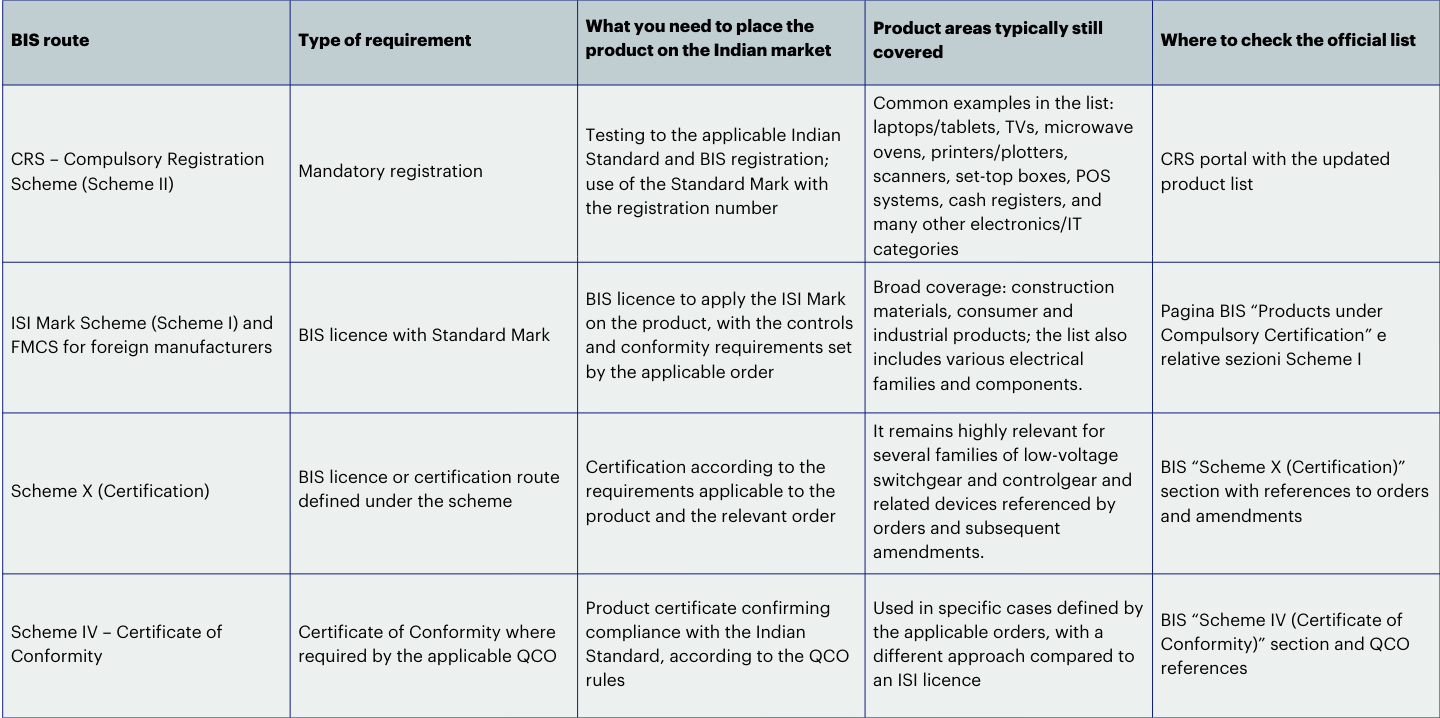
Below is a guidance table designed to help you understand which BIS routes may still apply and to which types of products, regardless of the OTR withdrawal.
A practical example: electrical appliances
Alongside “product-by-product” lists, there are also horizontal QCOs. One example is the Safety of Household, Commercial and Similar Electrical Appliances (Quality Control) Order, 2024, referenced by government sources, which extends mandatory BIS requirements to many electrical appliances within certain voltage limits, where not already covered by other product-specific QCOs.
What to do if you had an “OTR-only” project
If you had already started activities related to the OTR, it is best to proceed in an orderly way:
pause tests, technical files, and marking plans set up solely for OTR
verify whether the product falls instead under CRS, Scheme I, Scheme X, or Scheme IV based on the official lists and the applicable QCO
update documentation and align with the importer/distributor, especially if shipments or contracts are already in place
Want to quickly understand whether your products destined for India still require BIS, and under which route? Contact us: we can help you correctly classify the product category, identify the applicable scheme, and set up a clear and proportionate compliance pathway.