


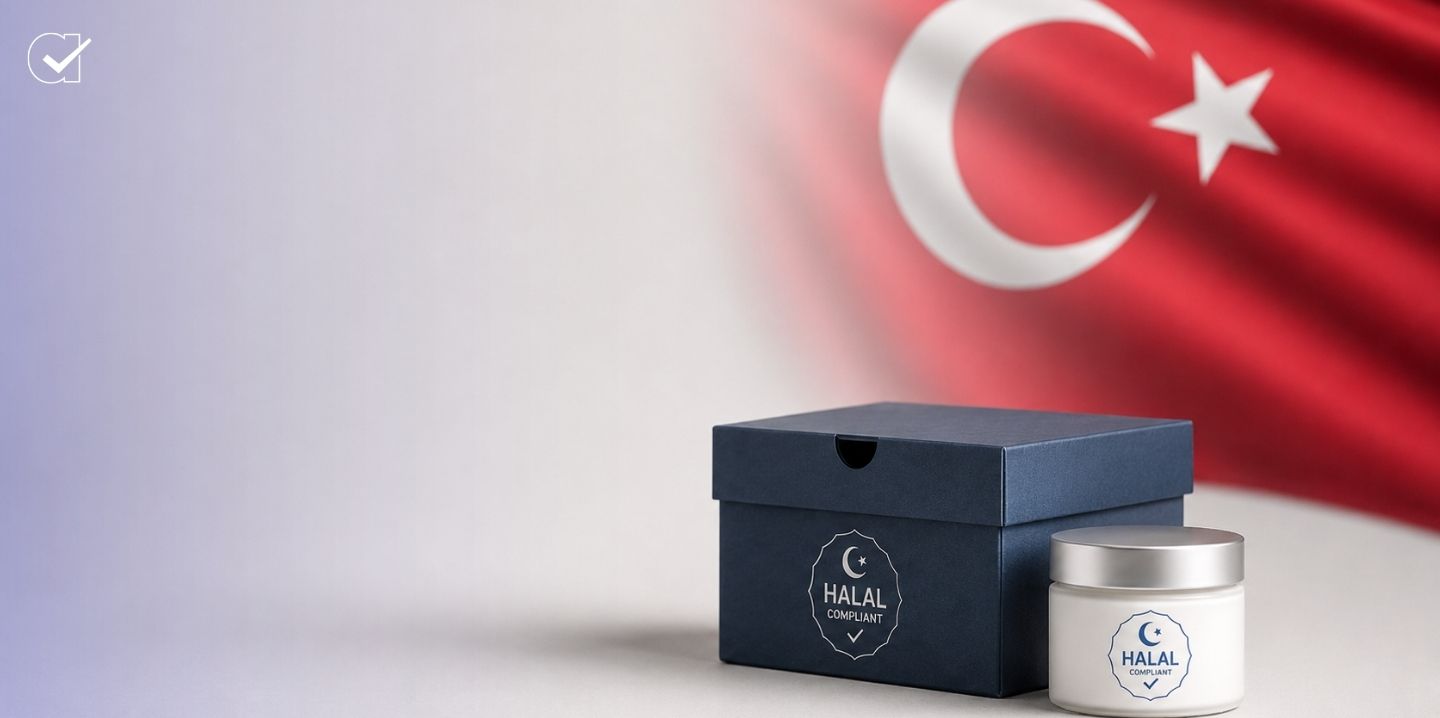
In Turkey there is no general requirement for Halal certification of consumer goods. Conformity assessment remains voluntary.
It becomes mandatory in only one case: when a product carries a logo, mark, or wording that communicates Halal conformity to the consumer.
At that point, certification must come from a body accredited by the Helal Akreditasyon Kurumu (HAK).
From September 25, 2026, this control is reinforced at customs with Tebliğ 2026/35, which introduces digital checks via TAREKS, the Turkish risk-based import control system.
Regulatory framework
The system originates with Law No. 7060/2017, which establishes HAK. The 2022 amendments confirm the voluntary nature of the assessment, regulating the bodies authorized to certify.
The Regulation of April 28, 2023 defines the procedures for documentary verification of imported products with Halal certification.
Tebliğ 2026/35 was published on June 25, 2026 (Official Gazette No. 33291) and applies from September 25, 2026. It introduces systematic checks on imports of products with Halal indications.
The principle: no claim, no obligation
A brand that does not use Halal signs or wording is not required to certify. The obligation is triggered only by the claim. From that point, the certificate must come from a body whose HAK accreditation scope is consistent with the product category: a food accreditation does not cover footwear or leather goods.
By category
Category | Obligation | Elements to verify |
Clothing / textiles | Only with Halal claim | Materials of animal origin, auxiliary substances |
Footwear | Only with Halal claim | Leather, glues, finishes, animal-derived components |
Leather goods and accessories | Only with Halal claim | Leathers, coatings, adhesives, waxes, fats, additives |
Cosmetics | Dedicated HAK program (OIC/SMIIC 4:2018) | Ingredients, process, cross-contamination |
Packaging | HAK schemes mainly for food packaging | Materials, inks, adhesives, claims on the pack |
TAREKS control
From September 25, 2026, any Halal reference on a product or its packaging requires documentation to be uploaded to TAREKS. The check can be documentary or physical, and also covers inner packaging. If the declaration is not compliant, the import can be refused.
There is a possibility of removing the Halal indication through methods approved by the authority; otherwise, the goods may be re-exported or destroyed. Responsibility for the data uploaded remains with the importer.
Packaging
Packaging is not, in itself, subject to certification, but it becomes relevant if it carries a Halal logo or wording. A shoebox with a printed Halal logo can trigger verification, even in the absence of a specific accreditation scheme for fashion packaging. Packaging with no Halal references does not require certification.
Compared to Indonesia
The two systems are not comparable. In Indonesia, Halal regulation introduces progressive obligations for entire product categories. In Turkey, the system remains voluntary: the obligation arises from the claim, not from the product category.
What to check
- Without a Halal claim: no direct obligation. It should still be verified that no SKU or packaging contains Halal references inserted in the past.
- With a Halal claim: the certificate must come from a HAK-accredited body with a scope consistent with the category.
- In both cases: from September 25, 2026, shipment requires coordination between the Turkish importer, customs broker, and certification body for TAREKS documentation.
How Analytical Can Support You
The risk in Turkey is not missing a mandatory certification — it is making a Halal claim without being able to back it up at customs.
Analytical supports fashion, footwear, leather goods, and cosmetics companies in this verification, before TAREKS does it for them.
For an assessment of your company’s position with respect to Tebliğ 2026/35, you can write to halal.certification@analytical.it.